Our services
 Click here to download image.
Legal Aid Ontario (LAO) will provide you with the services best suited to your legal matter. All our services are available in both English and French.
To receive assistance, you must qualify financially, and your legal matter must be one that LAO covers.
The type of service that works best for you will depend on your case and your financial situation.
Service Finder
The Service Finder can help you find the right services and resources for your legal issue in just a few clicks.
You may be asked different questions about your legal issue and your financial situation to determine which service(s) you may qualify for.
How the tool can help you:
- Available services for your legal issues in various areas of law, such as criminal, family, immigration, housing, disability and social assistance, mental health, etc.
- Directory of legal offices, such as legal clinics, legal aid offices, court offices, refugee offices, etc.
- Service provider information, such as address, hours of operation, languages offered and accessibility services
- Google Maps feature that helps you plan your trip and access real-time traffic conditions
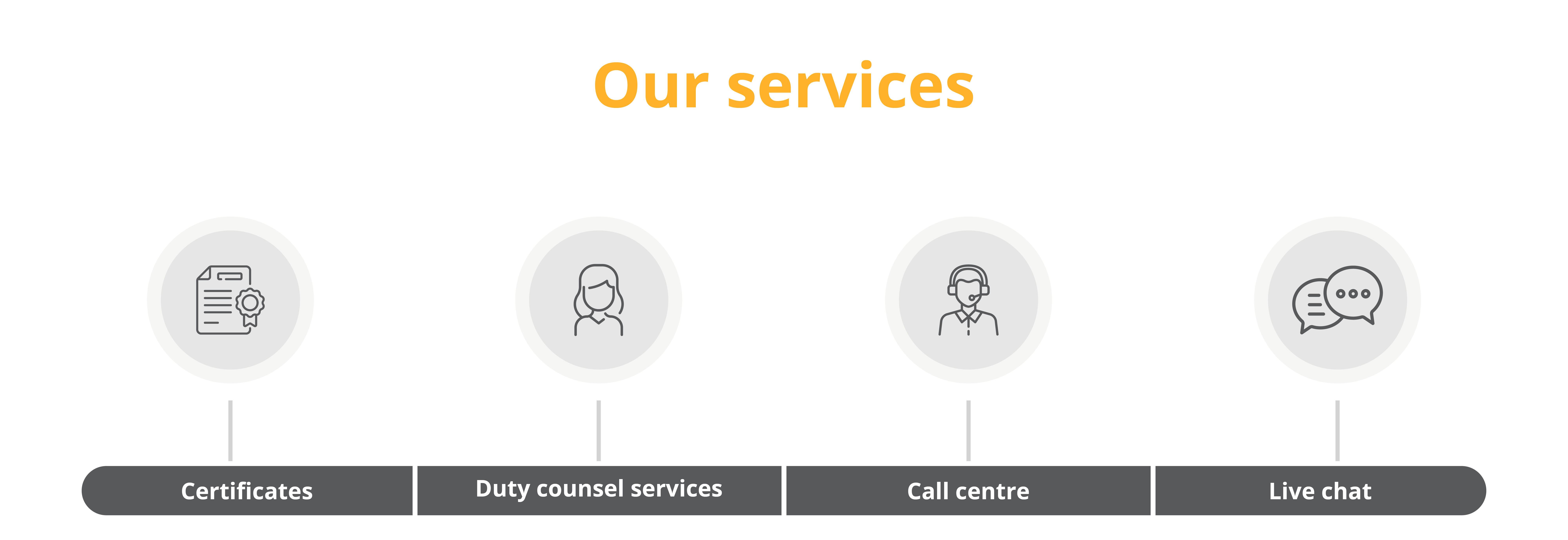
Certificates
If you qualify, LAO will provide you with a certificate that covers the cost of a private lawyer who accepts legal aid work for a certain number of hours. You can bring this certificate to a lawyer, and they will represent you in court throughout your case.
This is different from receiving duty counsel services because a lawyer from our certificate program may help you with your case on a long-term basis, while duty counsel can only help you on the day of your court appearance.
For more information, please visit:
Duty counsel services
If you qualify, LAO can provide you with a duty counsel lawyer who helps you on the day of your court appearance at no cost. Duty counsel are lawyers who can quickly assess a client’s legal problems and provide advice, information and representation to someone who would otherwise be unrepresented and unassisted in the courtroom. Clients can also speak with lawyers at Family Law Information Centres—located in most family courts—to get free general legal advice on family law issues and help with reviewing legal documents. Between court appearances, duty counsel may be able to help you negotiate a resolution or settlement of your case.
This is different from our certificate services because duty counsel do not do trials and may only be able to help with a part of your case, while a lawyer from our certificate program may help you with your entire case on a long-term basis.
For more information please see:
Getting help over the phone
Our Client Service Centre (CSC) can connect you to legal aid information and services by phone. You can call toll-free at 1-800-668-8258 or at 416-979-1446 if you are calling from Toronto or the GTA. These services are multilingual, confidential, and impartial.
Our call centre can provide a range of services, like:
- helping you with your legal aid application
- assessing your financial eligibility
- referring you to a duty counsel or legal clinic
- transferring your call to other provincial offices or organizations that can help you
Our call centre agents can also help legal aid clients with ongoing concerns related to the services they are already receiving from us. For example, our call centre agents may help reassess your finances, or they may assist with a request to change your lawyer.
Summary legal advice
Another important service we provide by phone is summary legal advice. Summary legal advice means that we give general advice that helps you navigate your case and the Ontario legal system. For instance, we can provide:
- information about court procedures, expectations and necessary documents required at your next duty counsel visit
- help with next steps to file/complete your case
- opinions on what legal action is best for specific cases
- strategies to help you resolve your case sooner
Live chat
Our live chat is an instant messaging service on our website. It allows you to send and receive instant messages with a client service specialist.
The live chat is a service for answering your general questions about LAO. The client service specialist is not a legal professional who can give case-specific legal advice, so please do not share personal information related to your specific legal concerns.
Client portal
Our client portal is a website that clients and applicants use to manage their information. This site is separate from our main legalaid.on.ca website.
You can find the client portal at client.legalaidonline.on.ca.
The client portal is a website you may use when you are applying for legal aid or when you are already a client with us. To use the portal, first you must create an account. After that, you will be able to log in and use the client portal to:
- Apply for legal aid
- Sign certain forms
- Send and look at application documents
- Check the status of your application
- Update information like your address and contact information
- Find a lawyer
Online applications take about 15 minutes to complete, and you are always welcome to apply by phone if you prefer.